
Why We Keep Failing to Make the Changes We Actually Want

There is a quote that has stuck with me for years:
True change happens when the pain of staying the same becomes greater than the pain of change.
The leader of the cult I was in used to say it to us all the time. As strange as it feels to admit, it was one of the few things from that experience that actually stuck with me as something useful. Is it unfortunate that it came from somewhere with so much BS? Yep. But it is also absolutely true.
Most of us don't fail to make changes because we don't want them badly enough. We fail because staying the same is easier.
Not better.
Not happier.
Not healthier.
Just easier. Because we already know how to do it. We know what tomorrow looks like when we keep doing what we've always done. We know the routines. We know the discomfort. We know how to cope with it. We know what to expect.
Change, on the other hand, is unknown. And when you're already exhausted, overwhelmed, stressed, or burned the fuck out, the idea of adding one more thing to your life can feel impossible. Even when that one thing is exactly what might eventually make your life easier.
Why Is It So Hard to Change When You're Burned Out?
That's the really frustrating part.
You know you need to sleep more, but creating a bedtime routine feels like work.
You know you need to move your body, but finding twenty minutes feels like one more obligation.
You know you need to eat differently, but planning meals feels exhausting. And let's be real...this whole food thing as an adult...no thank you. I'm over it.
You know you need to stop answering every damn message immediately, but putting your phone on Do Not Disturb feels uncomfortable.
You know you need to set the boundary...You know you need to make the appointment...You know you need to start the project...
You know.
And yet you don't.
That doesn't make you lazy. It makes you human.
When you're already running on empty, even positive changes can feel like additional demands on a system that is already overloaded. Which is why sometimes the thing that would ultimately make you feel better is the exact thing you have the least energy to begin. And this is where that quote comes back around.
At some point, the pain of staying exactly where you are becomes greater than the discomfort of doing something different.
That doesn't necessarily happen all at once. Sometimes it's one tiny realization. I can't keep doing this.
Sometimes it's exhaustion. Sometimes it's frustration. Sometimes it's realizing that the thing you've been tolerating for six months, six years, or six decades isn't actually something you want to keep tolerating.
And sometimes that's the moment change becomes possible.
But you decide to be an active participant in your life anyway. You make the single decision to pick which hard you're going to run with.
Motivation Isn't a Feeling
This is one of the biggest things I wish more people understood. We talk about motivation like it is something that magically arrives.
"I'll do it when I feel motivated."
Okay. But what happens when you don't? What happens when you're tired? What happens when you're pissed off? What happens when you had a shitty day? What happens when your brain would really rather sit on the couch and doom scroll for an entire day?
If we based our lives on feeling motivated, very few of us would accomplish very much. Because motivation isn't a feeling you wait for.
Motivation is a decision.
You decide that something matters enough to do. Sometimes you feel like doing it afterward. Sometimes you don't. Sometimes you don't feel like doing it at all. You do it anyway. And this is where learning that you can do hard things even when they're uncomfortable becomes incredibly important.
Not everything that feels uncomfortable is wrong. Not everything that feels difficult means you shouldn't do it. Sometimes discomfort is simply what happens when you're doing something new. Your brain likes familiar. Your nervous system likes predictable. And when you start doing something different, there can be a period where your entire system is basically going:
WHAT THE FUCK ARE WE DOING?
That doesn't automatically mean you've made the wrong choice. Sometimes it means you're learning. You can be nervous and still make the phone call. You can be uncomfortable and still say no. You can be tired and still take the walk. You can be afraid and still take the first step. You can be completely unmotivated and still decide what you're doing next.
You are allowed to feel uncomfortable and do the hard thing anyway.
Change Doesn't Have to Happen All at Once
When we've decided we are going to change something, suddenly we create an entirely new life on paper. New diet. New workout routine. New morning routine. New supplements. New sleep schedule. New planner. New boundaries. New business strategy. New personality, apparently. And then we try to implement all of it on Monday. By Wednesday we're exhausted. By Friday we've decided we "failed."
You didn't fail.
You tried to change your entire life at once. That's a completely different problem. Change can happen one step at a time. For most of us, it needs to. Make the change so small that your brain doesn't immediately start screaming that this is going to be terrible. Five minutes.

One phone call.
One glass of water.
One boundary.
One drawer cleaned out.
One walk around the block.
One less commitment.
One fucking thing.
Then do it again.
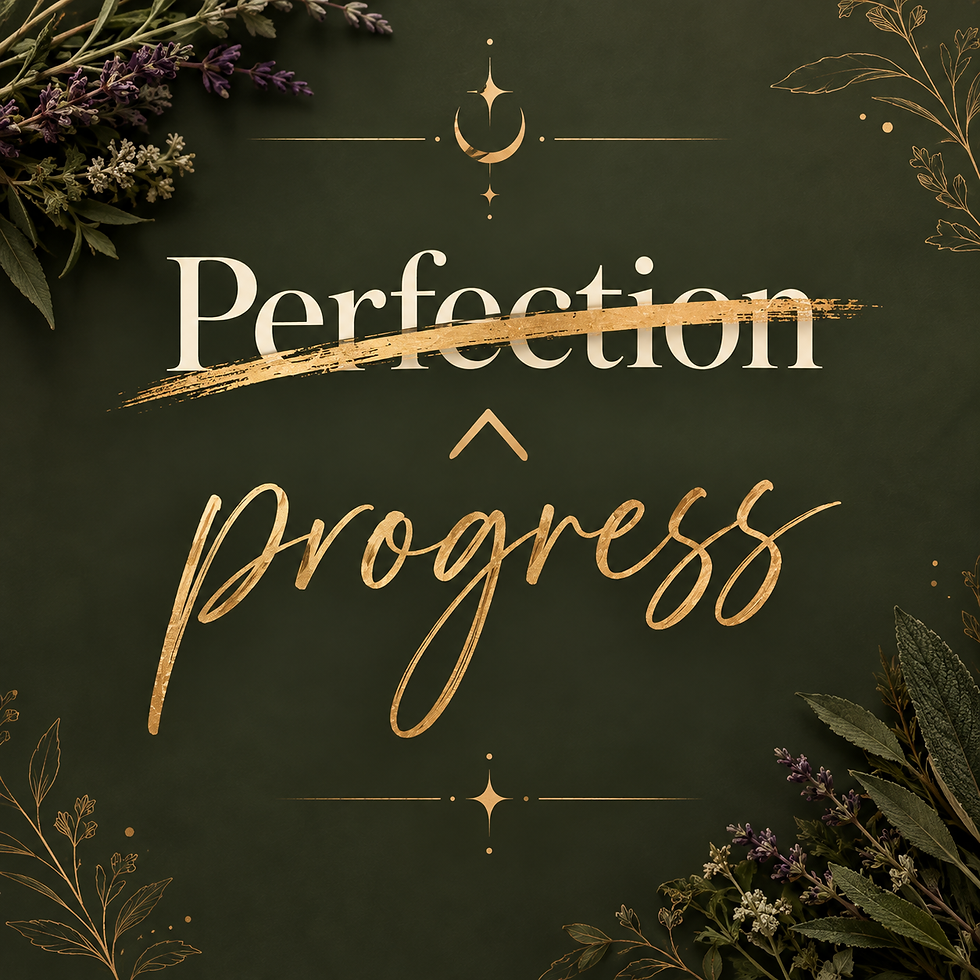
Small changes aren't insignificant. If you change ONE thing every single day, you've made 365 changes over the course of a year. That is life-changing.
They're how we teach ourselves that something different is possible.
And eventually, the thing that once felt unfamiliar becomes familiar. That's when change starts getting easier.
Can Herbs Help When You're Trying to Make Changes?
This is one of the places where herbalism can be incredibly useful. Not because an herb is going to magically make you motivated.
It won't. Sadly. No plant is going to climb out of the bottle, grab you by the shoulders, and make you clean your damn kitchen. But herbs can be used to support the body while you're navigating stress, mental fatigue, and the discomfort that can come with changing established patterns.
Withania somnifera (ashwagandha) is an adaptogenic herb with a long history of use in Ayurvedic medicine. Modern research has investigated preparations of ashwagandha for stress and sleep, although studies have used different preparations and the evidence isn't equally strong for every proposed use.
Ocimum tenuiflorum (holy basil), also known as tulsi, has a long history of traditional use and has been studied for its relationship with stress. One randomized controlled trial found that a standardized holy basil extract was associated with improvements in measures of perceived stress and sleep in adults experiencing stress. (Side note: That's interesting research, but one study is typically not enough evidence to make it conclusive.)
And then there's Melissa officinalis (lemon balm). Lemon balm has traditionally been used as a calming nervine, and clinical research has investigated its effects on anxiety, mood, stress, and cognition. A systematic review and meta-analysis found potential benefits for anxiety and depressive symptoms, while also noting substantial variation between studies and the need for better research.
These aren't herbs that "fix" your life. But they are amazing tools. And tools work best when you're actually using them alongside the other things that you're trying to accomplish. They are the decision that gives your nervous system the rest it needs to be able to make some of these other decisions.
What About Bacopa and Actually Getting Shit Done?

Then there's Bacopa monnieri.
This is one I particularly like talking about when we're discussing change because sometimes the problem isn't that we don't want to be productive. Our brains just aren't cooperating. When you're anxious, overwhelmed, mentally scattered, or struggling with ADHD symptoms, it can feel like your brain has seventeen thousand tabs open and somehow none of them are the one you actually need.
You know what needs to happen. You might even really fucking want to do it. But getting from I know what I need to do to I am actually doing it can feel like trying to cross a moat.
That's where I think it's useful to look at the whole picture instead of treating productivity like a character flaw. Bacopa has been studied for its effects on cognition, memory, attention, and anxiety, with research showing some pretty cool stuff in these areas.
Because ADHD isn't just about attention. For many people, executive function, working memory, anxiety, mental fatigue, and the ability to shift from thinking about doing something to actually starting it all interact. And when those systems are struggling, productivity can become incredibly difficult. Supporting cognition and a calmer mental state doesn't magically make you productive. It can, however, help create a little more room for your brain to notice, organize, focus, and act.
And that's the piece I care about. I'm not interested in helping an exhausted person squeeze twelve more hours of productivity out of themselves. I'm interested in helping the brain and body get to a place where doing the thing is actually possible.
Sometimes that means supporting stress. Sometimes it means supporting cognition. Sometimes it means working with the anxiety that's keeping you frozen. Sometimes it means finding strategies that work with an ADHD brain instead of constantly trying to force that brain to operate like somebody else's. And sometimes it means an herb is one small piece of that puzzle.
Because the goal isn't productivity for productivity's sake. The goal is having enough capacity to actually participate in your own life.
Talk to Yourself
And that brings me to something that feels absolutely ridiculous the first time you try it.
Talk to yourself.
Out loud.
Yes. I know. It feels fucking insane. You're going to feel like someone is going to walk in and catch you having a conversation with yourself. Do it anyway.
Putting thoughts into words can create a little distance between what your brain automatically says and what you actually choose to do.
Instead of:
"I can't do this."
Try saying:
"I don't have to do all of it. I only have to figure out the next step."
Instead of:
"I always do this."
Try:
"This is a pattern I've practiced. I can practice something different."
Instead of:
"I don't feel motivated."
Try:
"I don't need to feel motivated. I need to decide what I'm doing next."
It sounds ridiculous. It can feel ridiculous. And yet sometimes that tiny disruption is enough to interrupt the automatic loop and give you a moment to make a different choice. That's really what change is. Not one giant transformation. Not waking up one morning as a completely different person. Not finally becoming disciplined enough, motivated enough, organized enough, or whatever the hell else we've been told we need to become.
It's making a different choice.
Then another.
Then another.
Until the thing that once felt unfamiliar starts to become something you know. Because eventually, change becomes the thing we know. And that's when it gets easier. Not easy. But easier.
And sometimes that's all we need to keep going.
With love,


Comments