
Therapeutic Actions & Why They Matter

If you’ve spent any amount of time around herbalism, you’ve probably noticed something mildly annoying:
A whole lot of herbs seem to do the same damn thing.
So how do you know which one is the right choice? That is, unfortunately, a loaded question and is highly dependent on how deeply you want to go on the herbalism journey. One option is to look at the therapeutic actions.
Knowing that an herb is traditionally used for “stress” tells you what it may be commonly used for. Its therapeutic actions tell you how it approaches the problem. And that distinction can completely change the herb you reach for.
Three Categories. Similar uses. Very different jobs.
Let’s look at three categories that have extremely similar common uses but support them in wildly different ways: Nervines, anxiolytics, and adaptogens.
There is a ton of overlap between them, and some plants fit into more than one category depending on the chemical constituents, dose, and the effect you're after. But each one operates a little bit differently and can help support your system better than another.

Nervines: When the nervous system needs a little support
“Nervine” is a term you’ll hear me use a lot in the wild because I specialize in working with women who are experiencing high levels of nervous system dysregulation.
Broadly speaking, nervines are herbs used to tone the nervous system. They help to promote resiliency from within. Depending on the plant, that can mean calming nervous activity, easing tension, supporting sleep, or simply helping someone feel a little less like their nervous system is running a fucking emergency drill.
Melissa officinalis, or lemon balm, is a great example. Lemon balm has a long history of use for nervousness and related complaints, and modern research has investigated its effects on anxiety, mood, cognition, and neurological activity. Research has proposed several mechanisms for its neurological effects, including interactions with GABA-related pathways.
Clinical research also suggests lemon balm can improve anxiety and depressive symptom scores, with some evidence suggesting particularly useful effects in acute situations.
So if someone comes to me saying:
“I'm wound all the time for no reason.”
I'm thinking about herbs that interact directly with the nervous system. That's a different starting point than:
“I've been under chronic stress for six months and I feel completely depleted.”
Those two people might both say they are “stressed.” But their bodies may need very different things.
Anxiolytics: The goal is anxiety reduction
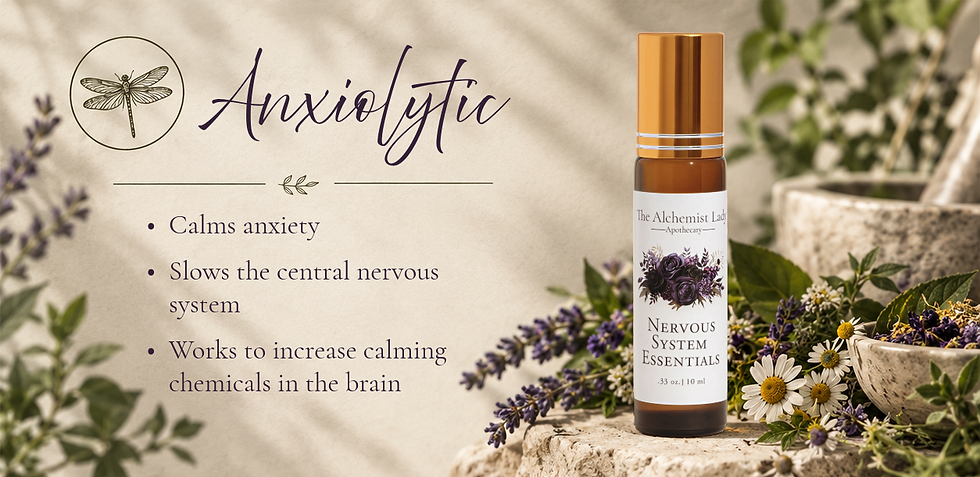
Anxiolytics can absolutely support stress, but they are a little more specific.
It describes an action that reduces anxiety.
That doesn't necessarily mean an herb is inherently a “calming herb,” and it doesn't mean every herb traditionally used for nervous tension qualifies as an anxiolytic based on clinical evidence.
This distinction is really important.
Lavandula angustifolia (True Lavender) is probably one of the most well-known and most studied anxiolytics available. Others include Citrus sinensis (Sweet Orange) and Chamaemelum nobile (Roman Chamomile) essential oils, along with Lemon Balm, Withania somnifera (Ashwagandha), and Passiflora incarnata (Passionflower).
Passionflower has traditionally been used for anxiety, nervousness, and sleep, and research has investigated its interaction involving the modulation of GABA-related signaling, although the precise mechanisms are still being worked out. Clinical research has also found promising evidence for reductions in anxiety, although the evidence base has limitations and researchers have called for better-designed trials and standardized preparations.
And then we have adaptogens

This is where things get particularly interesting. Because adaptogens aren't simply “herbs that make you calm.” In fact, that's a pretty shitty explanation of what they do.
Adaptogens are generally discussed as herbs that influence the body's response to stress and help support physiological adaptation and homeostasis. Research has connected their activity to multiple systems involved in the stress response, including the hypothalamic-pituitary-adrenal (HPA) axis and other cellular stress-response pathways.
One of the herbs you've probably seen me talk about is Withania somnifera, commonly known as ashwagandha. This is an herb that gets talked about A LOT. And for good reason.
Here's where the overlap gets interesting.
Ashwagandha has been studied for stress and anxiety. A systematic review and meta-analysis of randomized controlled trials found improvements in measures of perceived stress, anxiety, and cortisol compared with placebo. The researchers also noted limitations in the available evidence and the need for more information about long-term safety, but we also have GOBS of historical research from across the globe to show how this herb interacts within the system.
So yes...ashwagandha can show up in a conversation about anxiety. But how it supports anxiety is completely different. Its relationship with stress is broader. It works to tone the entire body and, as a result, can help other symptoms.
Instead of simply asking:
“How do I make this person feel calmer?”
we can ask:
“What is this person's stress response doing, and what kind of support does their system need?”
That's a much better question.
Same symptoms. Different root causes.
This is the part I wish more people understood about herbalism. Outside of clinical herbalism, we tend to organize herbs according to what they're used for.
Stress herbs.
Sleep herbs.
Digestive herbs.
Immune herbs.
Pain herbs.
And while that is useful for getting started, it doesn't give us the whole picture. Because symptoms aren't the whole picture.
Two people can both say:
“I'm stressed.”
One person might be wired, restless, tense, and unable to sleep. Another might be exhausted after months of carrying too much. Another might experience significant anxiety that interferes with daily life.
Another might be physically tense but mentally fine. Another might have a combination of all of the above because apparently the human body enjoys making things complicated.
These situations have overlapping herbal options. But that doesn't mean the same herb is the best choice for every person. And unless we are getting to the root cause of what is causing the symptoms, oftentimes we see absolutely zero relief.

This is why therapeutic actions matter
When you understand therapeutic actions, you stop asking:
“What herb is good for anxiety?”
And you start asking better questions.
Is this nervous-system tension? Is this an anxiety response? Is this chronic stress and depletion? Is sleep the primary problem? Is the person overstimulated, exhausted, tense, or some combination of the three? Do I want an acute effect, or am I trying to support a longer-term physiological pattern?
Now we're getting somewhere. We're not just matching a symptom to a plant. We're looking at the relationship between the person, the symptom, the therapeutic action, and the herb.
Why we use more than one herb
This is also why herbalism doesn't always have to be about finding the one perfect herb. In fact, multi-herb formulations tend to work better for most people. A person experiencing chronic stress benefits from an approach that addresses more than one piece of the picture.
A nervine that supports the nervous system. An anxiolytic that addresses anxiety-related symptoms. An adaptogen that supports the body's response to ongoing stress.
When a plant can offer more than one of these actions, we may still intentionally choose an herb from each action. That's where formulation gets really interesting (and really fun). You're no longer throwing a handful of “calming herbs” into a bottle and hoping they get along. You're intentionally making selections based on a knowledge base that allows you to go deeper. You're asking what each plant is strongest in and then adding to it's strenghts while filling in its weaknesses. We call this synergy.
A quick note on the science
The terms nervine, anxiolytic, and adaptogen don't function as perfectly standardized clinical categories, and the evidence for individual herbs varies considerably. “Adaptogen,” in particular, is a broad pharmacological concept whose mechanisms and clinical applications continue to be debated.
So when I talk about therapeutic actions, I'm not suggesting that every herb neatly fits into one category or that traditional terminology automatically equals clinical proof. I'm talking about using these concepts as a framework for asking better questions—and then looking at the evidence for the specific plant, preparation, dose, and situation. Because “it's an herb” isn't enough. Knowing what you're working with matters.
With love,


Comments